Saturday, June 4, 2016

Chapter 4: Working In the Digital Age

Photojournalism has changed dramatically over time with the new development of technology. In the digital era that we live in today, it is no surprise to see people using hand held devices to capture snap shots of the high way car accident, or the cat that got stuck in a tree. People in our society now have become tech savvy and they are using it to their advantage. Well, more updated technology is being created believe it or not and it is making its way into the world of photojournalism.

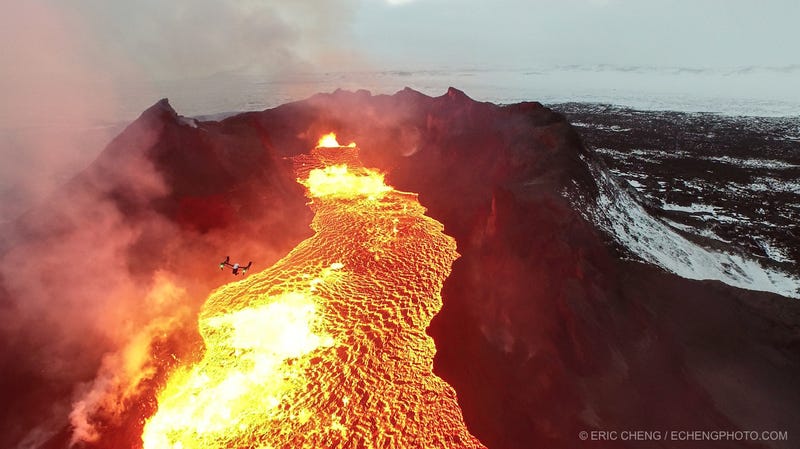
 Drones are beginning to take over. In case you’ve never heard or seen a drone, it reminds me of something you’d see in a futuristic movie. It is unbelievably high tech and it is almost too good to be true. For photojournalist today, they serve as a convenient tool for them to report the latest news stories. They also serve as a protective barrier for those who put themselves out there to capture the best image possible. Harry de Quetteville quotes Kevin Carter, a well-known photojournalist on his views on drones: “An unmanned drone has no fear, no family, and no doubts. It will fly into the most dangerous, openly hostile environment and capture the best, most incredible images that us ‘real’ reporters could ever hope for”. His thoughts make a great point— the lives of photojournalist would be safer, and they would be able to conquer any project with no limitations.

Image by: Eric Cheng
Image source: http://gizmodo.com/how-to-turn-drone-photography-into-breathtaking-art-1739847364
 Drones are devices that are multipurpose. People around the world can use them differently. They can be used to transport AED’s to dying people, or they can be used to capture soldiers at war. This new innovation has been designed to do just about anything. The pros of this amazing innovation have served as a new stepping stone for photojournalists. Stevesandberg mentions in their article about drones that “drones have the potential to be a powerful tool for photojournalists, allowing them to take aerial photos, capture vast images, and shoot airborne footage that can help tell print and TV stories in new and unique ways". This could not be any truer. The possibilities are endless; projects high and low can be covered using the smart drone.

Image by:Tomas van Houtryve
Image source: http://time.com/3627980/drone-country-see-america-from-above/
As professor Nordell mentions in his video on The Digital mindset, he states, “different people take in information in different ways” and this is extremely true. Compared to the way photographs were taken in the 1800s, the wet plate collodion process was the only source of technology they could use to capture images. It was a long and tedious process, but the new digital age has changed that completely. Yes both were used as means of communication and insight, but technology today has made it possible to capture clearer, closer and brighter images. Drones have proven to us that no matter the size or height, anything can be captured. Unlike the older pre-digital cameras, drones are capable of anything. Dallas News says that “today’s professional photographer needs only a backpack to carry everything for shooting and delivering photos”. This is very true. Photojournalist are adventure filled individuals that are ready to take on the next big news hit. And with the creation of drones and new technology, they won’t need anything but their artistic eye for amazing photos.
Thursday, June 2, 2016

Chapter 3: The Art of Photojournalism


Image by: Trumbull White
Year created: 1898

Subject Expression: She is slightly smiling, but has a soft look on her face. She is looking away from the camera, not making any eye contact, almost as if she were being flirtatious. Her body seems relaxed, and pure.

Quality of Light: The lighting in this image appears dull and flat. There is not much contrast but perhaps too much exposure in certain areas. The picture is more on the gray scale of the spectrum and does not use any bold statements.

Background Compliment: The photographer focuses on just the Afro-Puerto Rican women; he also includes the village people in the background as accessories that compliment her. The people add character and incorporate her origin. They show where they come from, and how they live.

Why did I choose this image? I chose this image because my mother’s family originates from Puerto Rico. This photo captured a different take on Latina women and how they look. Not all Puerto Ricans are of light complexion. We are a race of different shades of skin and hair texture. This image shows the beauty of the Afro-Puerto Rican women that are a part of our family ancestry.


Image by: Unknown
Image source: http://www.enciclopediapr.org/ing/section_mm_photo.cfm?cat=42
Year created: 1946

 Use of Shadows: In this image, the dark shadows give it a gritty look, showing the roughness of the dirt under the boy’s fingernails. It brings forward darkness to the image, which to me demonstrates the hard work the body in this pueblo go through selling newspapers.

 Exposure Time: the picture was captured at a slower shutter time. The image does not appear to be of any movement; the child was simply standing holding the newspaper in his hands. The photographer did freeze a moment in time where the boy is holding the papers in his hand, and it captured it at the very right moment while the boy was looking away.

 Image Black and White: this photo was taken in black and white. The photographer did have a choice in the selection of color, but chose otherwise. This was likely done because during this era, photojournalism was mainly seen as black and white. The reason for that is because black and white seems more life-like and natural.

Why did I choose this image? This photograph captured my attention because of the young boy holding the newspaper. It appears as though he is selling the paper for money. Money probably to give to his mother so that she can buy rice and milk so she could feed her family. Puerto Rico was facing a very difficult time in its economy at this time in history, and young boys and girls were expected to work hard to help provide for their families. This image also shows the side of childhood. The smile on his face reminds me of the way children grow up on the island; filled with smiles and sincerity.


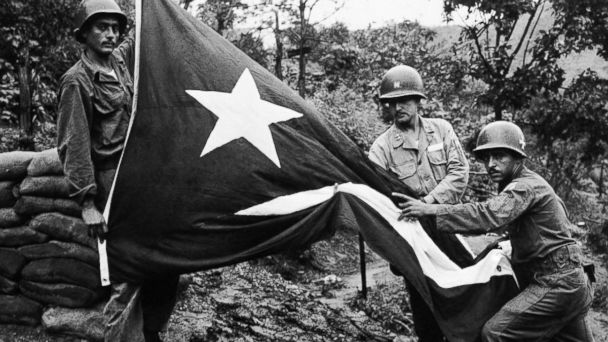
Image by: Courtesy of the Borinqueneers Congressional Gold Metal Alliance
Image source: http://abcnews.go.com/blogs/headlines/2014/06/a-soldiers-mission-to-honor-segregated-65th-regiment-borinqueneers/
Photo created: 1952

 Abstraction: this photograph is a representation of the men of Puerto Rico that died defending both their island as well as the United States of America. Many of the men in this photograph did not get the opportunity to get recognized for their service.

What Feelings Does This Image Create? It creates strength and dignity. You can see that these men are tired, but they hold their flag proudly. You can tell that they fought harder than they ever have in their life. The image captured a rare photograph of the special group of men that contributed to our country’s history.

 What in the Image Helped Create That Feeling? The flag played a big role in drawing in the emotions. The way these men made sure to take a photo of themselves with the flag shows how important it is to them, and to their island of Puerto Rico.

What made you choose this image? I picked this image for a few different reasons. While I was looking up photographs of Puerto Rico, this picture appeared. I did more research and I learned that this group of men were the first and only group of all Puerto Rican men in the US Army—The Borinquenners of the 65th Regiment. They fought in the Korean War, and in 2014 were given gold medals of Honor by President Barack Obama. After discovering this I became so happy. I learned something new about my heritage and the history of the island that my family calls home.


Wednesday, June 1, 2016

Chapter Two: Pre-Digital Photographic Technology

Photo by: Anonymous- A veteran with his wife
Image Source: https://en.wikipedia.org/wiki/Collodion_process
The collodion process is the invention that opened the door to photojournalism. The technique that was used was different than any other, and gave photographers the opportunity to take their work on the road. This was made possible by F.Scott Archer, the creator of the Collodion process. Its work was published in1851, but it was not until 1855 that this image process replaced both the daguerreotypeand the calotype process. This was brought forward by William Henry Fox Talbot. What exactly is the wet collodion process? It consists of six chemistry specific steps that are crucial to the process of taking and developing photographs. Without them, the photographs wouldn’t have their character and beauty. Alternative photography states that this process is used to makedifferent image types: The Ambrotype, the Tintype, and a negative. They also mention the important steps needed in order to successfully take and develop a photograph using this process.

The development of the wet collodion process led the path the success of many photojournalist; for instance Rodger Fenton. Many would claim that because of him, the birth of photojournalism happened, and made the impossible, possible. In 1855, he was sent to Crimea to capture the gruesome photos of wounded soldiers and to help tell the stories of these resilient men. He used the wet collodion process to take all those images, and he did it differently than most. He took all his equipment and put it inside a truck and therefore he was able to travel and photograph everything around him. This showed others that if he could do it, so could other photojournalist.

Unlike the photojournalist of today, Fenton had to only photograph still objects. And that’s what happens when using a collodion process. It becomes more difficult to capture the point of interest if it is moving. But nonetheless, Fenton changed how photojournalist photographed their images, as well as creative innovation on how to use the collodion process. Uncc.edu mentions a statement given by Evans that reads: “Roger Fenton, who was in a way the father of modern photojournalism,took a photo wagon to Crimean War with the deliberate aim of taking photographsthat would boost domestic morale…(Evans 32)
Photo By: Alejandra Ocasio

The photograph I share today has important meaning not only to myself, but to my family. We are a small, but strong and united. We will always be there to hold on another up when we feel like we can no longer stand our own two feet. The day I took this photo was a day that I will never forget. When I took that photo, I had no idea what photojournalism was or what it even meant. But now I can reflect; and understand the artistic side of this image. It is very different than the photographs Fenton took and from images taken by the wet collodion process, but yet it is so similar. When using the wet plate, there are many techniques that are used and specific solutions required in order for the image to come out as clear as possible. Even though I did not use any of those specific products, I too had to use proper technique to capture this image. My photograph looks nothing like the ones produced by the wet plate, but without the invention of the collodion process, it would have been impossible to capture mine. I now have the opportunity to capture an image on my phone or on a handheld camera and be able to save it for many years to come. Civil war trust states “Today pictures aretaken and stored digitally, but in 1861, the newest technology was wet-platephotography, a process in which an image is captured on chemically coatedpieces of plate glass. This was a complicated process done exclusively byphotographic professionals” . That could not be any more true. In the world we live in today, anyone has the ability to capture beautiful photographs and share them with the world, like the way I am today.

Friday, May 27, 2016

Chapter 1-Can Photogrpahs Change the World

We live in different worlds, yet we share the same planet. Photographs impact everyone differently, in a way that what might change someone’s life, change their views on the world, or how they view themselves and the people around them. These deeply captivating pictures are being taken every day, but some do not make it into the spotlight to shine and receive its proper recognition. Why it that? Well— 90% of everything we see, hear and read is controlled by 6 most companies according to Business Insider.

The pictures taken by talented photographers and photojournalists are the ones that get published and viewed by many. Images like the ones seen in National Geographic and Time magazine are all ones that get honorable acknowledgment. The people that take these astounding photographs are the same people that risk their lives to cover the news that is taking place around us. National Geographic states that “Photographers use their cameras as tools of exploration, passports to inner sanctums, instruments for change”. Photographs like the one taken of Elizabeth Eckford do just that. This image showed one of the first black students to go to an all-white high school in Arkansas. At this point in time, this was a very important news that was captured for America to see. This was ground breaking information that was taken in that moment and now a part of our country’s history.
Photo by: Will Counts, 1957
Image Source: http://www.photographyschoolsonline.net/blog/2010/30-photos-that-changed-the-world/
 
Robert Draper from National Geogrphic states “a great photograph can explode the totality of our world, such that we never see it quite the same again”. The image taken of Iskra Lawrence is a definition of that. There’s a big number of- people that have manipulated what the essence of beauty is. They forget that there are 3 billions of people on this planet, and that’s how many different types of beauty there is in the world. Beauty is in the eye of the beholder and there are no rules, or guidelines that define what true beauty is. Instead of embracing what we were born with, we try to change ourselves to fit the “standard” that has been set by the media. Our personality is lost within the bristles makeup brushes and behind the baggy shirt that covers the natural curvature of our bodies. Women have lost their voice along with self-esteem to fitl the media’s generalized status quo. This images represents how women should embody their identity. This model has become the new face for Aerie, showing off their new undergarments and swim wear. She has inspired millions of women and young women in the world to love and apprechiate themselves, no matter their size. She demonstrates body positive attitude and puts to shame those who think otherwise.This image alone changed my self-image. It taught me that it should not matter how much a woman weighs or how tall she is to be beautiful. The photo is comical yet speaks out to many women facing difficulty loving who they are and what they looks like. I see this photo and I instantly become motivated to block out my own inner negativity and begin to love myself, despite what anyone else has to say.
Photo by: Instagram/iamiskra
Image Source: https://www.yahoo.com/news/plus-size-model-shuts-down-fat-shamers-in-most-123148840.html
 
James Nachtwey from Time states “It’s the combined work of all of us, together, that builds the critical mass of information and insight that creates change and helps make the world a better place”. This is in fact very true. Citizens like myself and others in the community have a voice, and it should be heard. the photographs taken by average day people are what shine light onto real, true stories. Famous social media accounts are booming with regular people taking photos of the life around them, the struggles that they face and overcome. Those are the ones that are creating impact on the world without knowing it. CNN iReport speaks about Citizen Journalism and mentions: “Journalism has been forever changed --thanks to the fact that people can interact with media organizations and share their opinions, personal stories, and photos and videos of news as it happens” . Photojournalism has progressed so much over the years. All pictures can change the world and the talent of capturing the rawness of each story is purely something that should never be hidden.


Monday, May 23, 2016

Introduction to the History of Photojournalism

What is photojournalism? When these words are separated, they have two different meanings. According to the Icon Photography School, “Photojournalism is the process of storytelling using the medium of photography as your main story telling device. While a journalist will use their pen and paper to tell stories, a photojournalist will use their camera to capture the visual representation of a story”. There are many key parts that make up the talent of a photojournalist. They have been exhibiting their work for centuries. Their work is used to depict the news that is taking place currently, whether it is local, national or global. Photojournalist are brave individuals who risk their lives to capture the perfect shot.

As mentioned by Light Stalking, “the very first printed journalistic photos had to be interpreted from engravings. This practice started in 1853 when the first known photojournalist landed on the scene. Carol Szathmari, a Romanian painter and photographer, documented the Crimean War”. This was the breaking point in photojournalism. The images captured were being used as evidence and resourceful information in the news, for everyone to see.


Light Stalking also states that Dorothea Lange, Walker Evans and Gordon Parks were the photojournalists of the Golden Age. These photographers took some of the greatest images publically seen as well as honorable recognition. It all began with these courageous people who stepped out into the world to create what we call history. Images like the the Migrant Mother by Dorothea Lange are what paved the way of photojournalists
Photo by: Dorothea Lange
Photojournalism is a fascinating field of work, but without knowing its origin and the key components that make up this profession, you will not understand its true glory. Like professor Nordell mentions in his video, "the skills and attributes to being an effective photojournalist is having good ethics, fairness, unbiased and familiar with the most up to date news stories". And as a photojournalist, you must study the past and the present in order to become the best you can be. The history of photojournalism holds the key to success in this field of work. This field Is distinct from other lines of photography. Wise Geek states “A photographer who follows traditional farmers in rural England is a documentary photographer, but one who takes pictures of the aftermath of a suicide bombing for publication in the news is a photojournalist.”
Photo by: Thomas E. Frankin
Image Source: https://journoprof.co/